What is an integrated condo?
An integrated development combines private homes with public amenities on one site. Typically, that means a condo with a bus interchange, a hawker centre, a community club or a mall below the residential towers. In Singapore, these sites are usually released by the government with the public components written into the tender conditions.
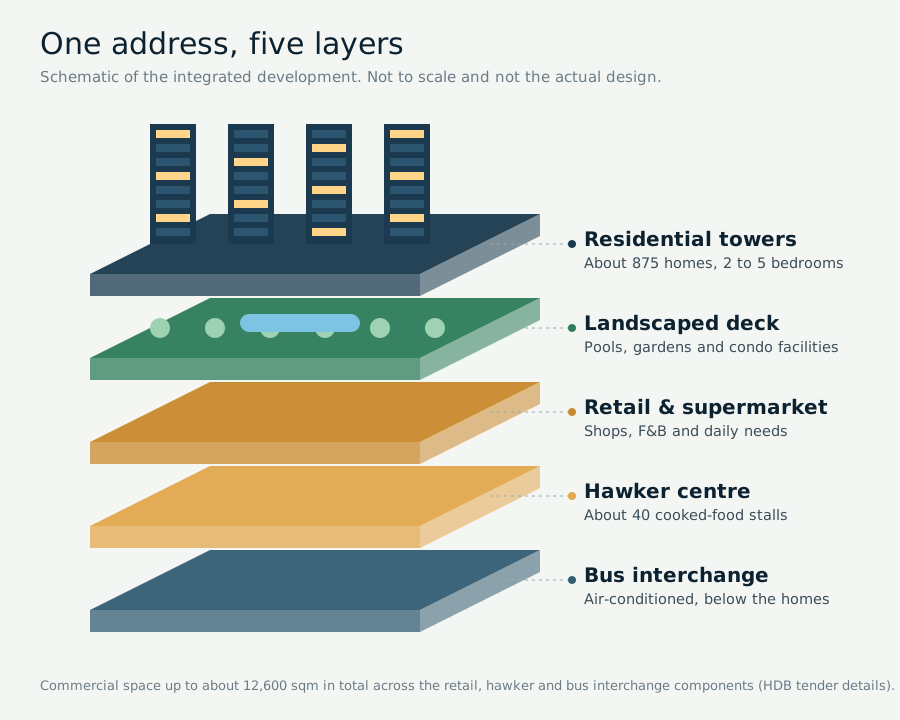
The advantages
Door-to-bus in minutes
Feeder and trunk buses leave from downstairs. That is useful in the rain and handy for children and older family members.
Hawker food downstairs
Affordable meals without driving or crossing roads.
Daily errands sorted
A supermarket, clinics and shops under the same roof.
Wider tenant and buyer pool
Convenience appeals to tenants, older buyers and families without cars.
The trade-offs
- Crowds. The public areas can be busy at peak hours and weekends.
- Noise on lower floors near bus entrances and loading bays.
- Price premium. Integrated projects are usually priced above standalone condos nearby.
- Access design matters. Look for separate residential lobbies, drop-off points and security.
How to pick the right stack
- Ask for the levels plan showing where the bus entrances and exits are.
- Choose a floor high enough to clear the podium roof and any exhaust vents.
- Prefer stacks facing the residential deck, parks or green links over those facing the bus approach roads.
- Check the walking route from your lift lobby to the MRT and the interchange.
Chencharu Central Residences vs other integrated projects
Chencharu Central Residences pairs its bus interchange with a hawker centre of about 40 stalls and retail, and has mid-rise blocks of about 12 storeys. That is lower than many integrated towers. Read how it compares with the most recent integrated launch in Chencharu Central Residences vs Parktown Residence, or see the site plan guide.
Frequently Asked Questions
Which condos in Singapore have a bus interchange?
Integrated developments with bus interchanges include Parktown Residence (Tampines North), and earlier projects such as Northpark Residences (Yishun), Sengkang Grand Residences, Pasir Ris 8 and Bukit Batok's Le Quest, among others. Chencharu Central Residences will join this group.
Is it noisy living above a bus interchange?
Modern interchanges are enclosed and air-conditioned, which keeps most noise and fumes inside. Units on low floors right next to bus entrances are the most exposed. Higher floors and stacks facing away from the entrances are usually quieter.
Do integrated condos hold their value better?
Integrated projects often attract strong buyer and tenant interest because of the convenience. Values still depend on price paid, market conditions and the specific unit. There is no guarantee.
Do residents pay for the bus interchange's upkeep?
Generally, no. The public components are typically owned or leased and maintained separately from the residential strata. Check the strata arrangements in the sale documents.